
How to Identify Carpenter Ants vs. Regular Ants
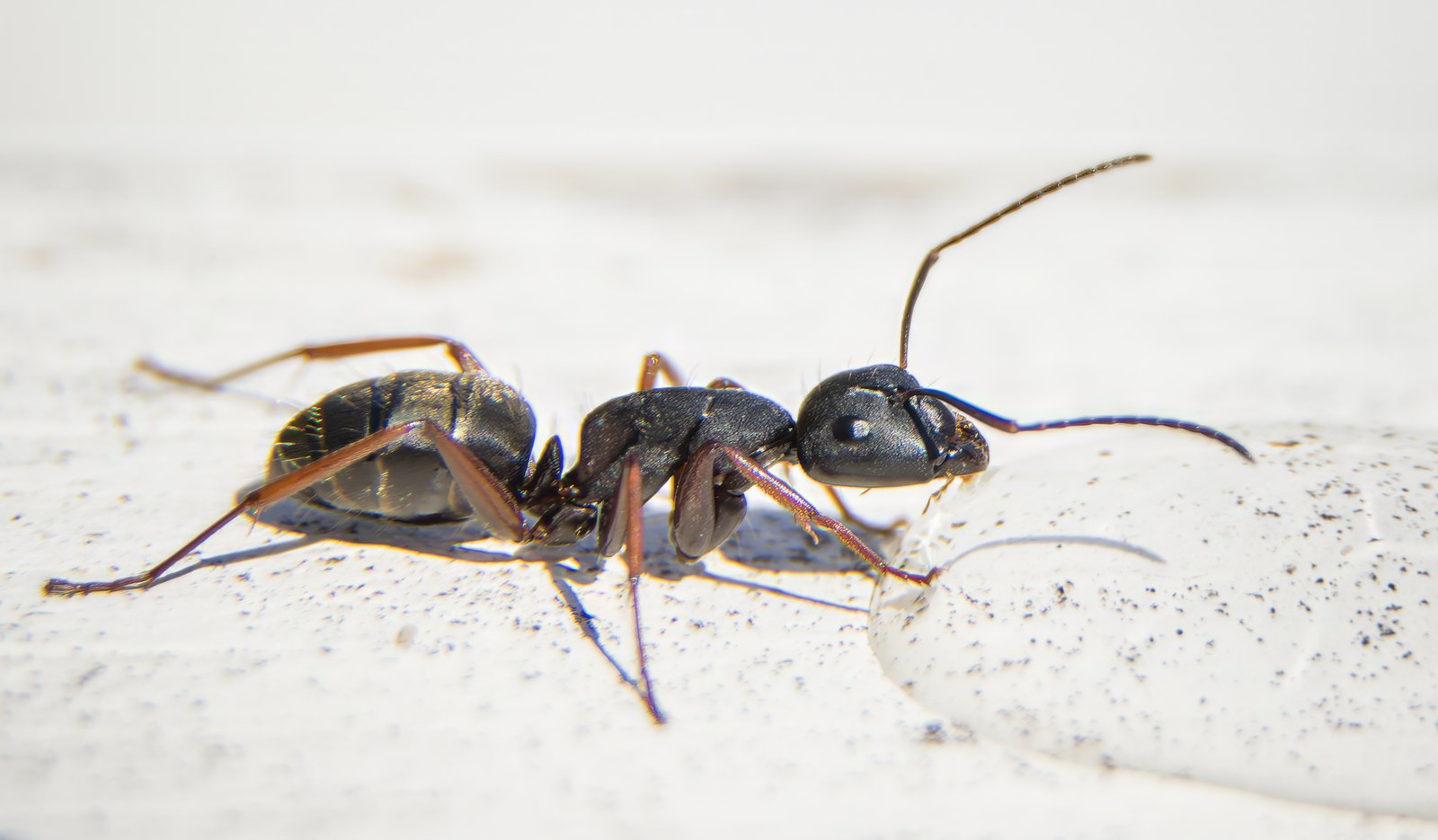
Not every black ant in your kitchen is a carpenter ant — but if it is, you need to know quickly. Carpenter ants are the only common Illinois ant that can structurally damage your home, and the longer they go unidentified, the more it costs to fix.
Here’s how to tell them apart from the other common species you’ll see in Plainfield and the surrounding area.
1. Size and Body
Carpenter ants are the largest pest ants in Illinois — workers run from a quarter-inch to over half an inch long. Pavement ants and odorous house ants, by comparison, are usually under an eighth of an inch. If the ant is big enough that you can clearly see its body segments without squinting, you’re probably looking at a carpenter ant.
Color matters less than people think. Most carpenter ants in our area are uniformly dull black, but some species are reddish-brown or two-toned (black abdomen, reddish thorax). The pavement ants you see crawling out of sidewalk cracks are also dark, but they’re tiny by comparison.
2. Thorax Shape (the giveaway)
Look at the ant from the side. A carpenter ant’s thorax — the section between the head and the abdomen — has a smoothly rounded, even profile. No bumps, no spines, no irregular shapes. Just a clean curve.
Every other common pest ant in Illinois has a different thorax shape:
- Pavement ants have two visible spines on the back of the thorax
- Odorous house ants have a flat, sloped thorax with a lump near the back
- Acrobat ants have a heart-shaped abdomen that they often raise when alarmed
If the side profile is a clean smooth curve, you’ve got a carpenter ant.
3. The Frass Test
Carpenter ants don’t eat wood — they excavate it. As they tunnel through damp framing, deck posts, or window trim, they push the chewed-out material back out of the colony. That debris is called frass, and it looks like fine sawdust mixed with bits of dead ants and insect parts. You’ll find it in small piles below where the colony is active.
Pavement ants leave dirt piles in cracks of concrete. Carpenter ants leave wood shavings. If you find sawdust-like piles near deck posts, basement window frames, or under interior wood trim, you have carpenter ants — and they’ve been working for a while.
Why the Difference Matters
Carpenter ant damage accumulates silently. A mature colony can include 10,000 workers and live for over a decade — and the queen can keep producing new generations the whole time. Once they’re established in your home’s wood framing, the galleries they excavate weaken structural members year over year.
Pavement ants and odorous house ants are nuisance pests. They invade kitchens, leave trails, are gross. Sprays from the hardware store will knock them back temporarily.
Carpenter ants are a structural concern. They require targeted treatment that locates and destroys the parent colony — usually outdoors, sometimes inside a wall or tree — not just the satellite workers you see indoors.
If you’re not sure what you have, take a clear photo (a coin next to the ant for scale helps) and send it to us. We’ll identify the species and tell you whether it warrants professional treatment.