The Best Way to Get Rid of Ants Permanently
If you’ve fought ants every spring for years, you already know the pattern: see the trail, spray the trail, ants gone for a week, ants back two weeks later. Sometimes in a different spot.
That’s not because you’re doing it wrong. It’s because over-the-counter ant sprays are designed to kill the workers you see — and the workers you see are the smallest part of the actual ant colony. The real problem lives somewhere else, and as long as the queen is producing new workers, you’ll keep seeing them on your counter.
Here’s what actually works.
Step 1: Identify the Species
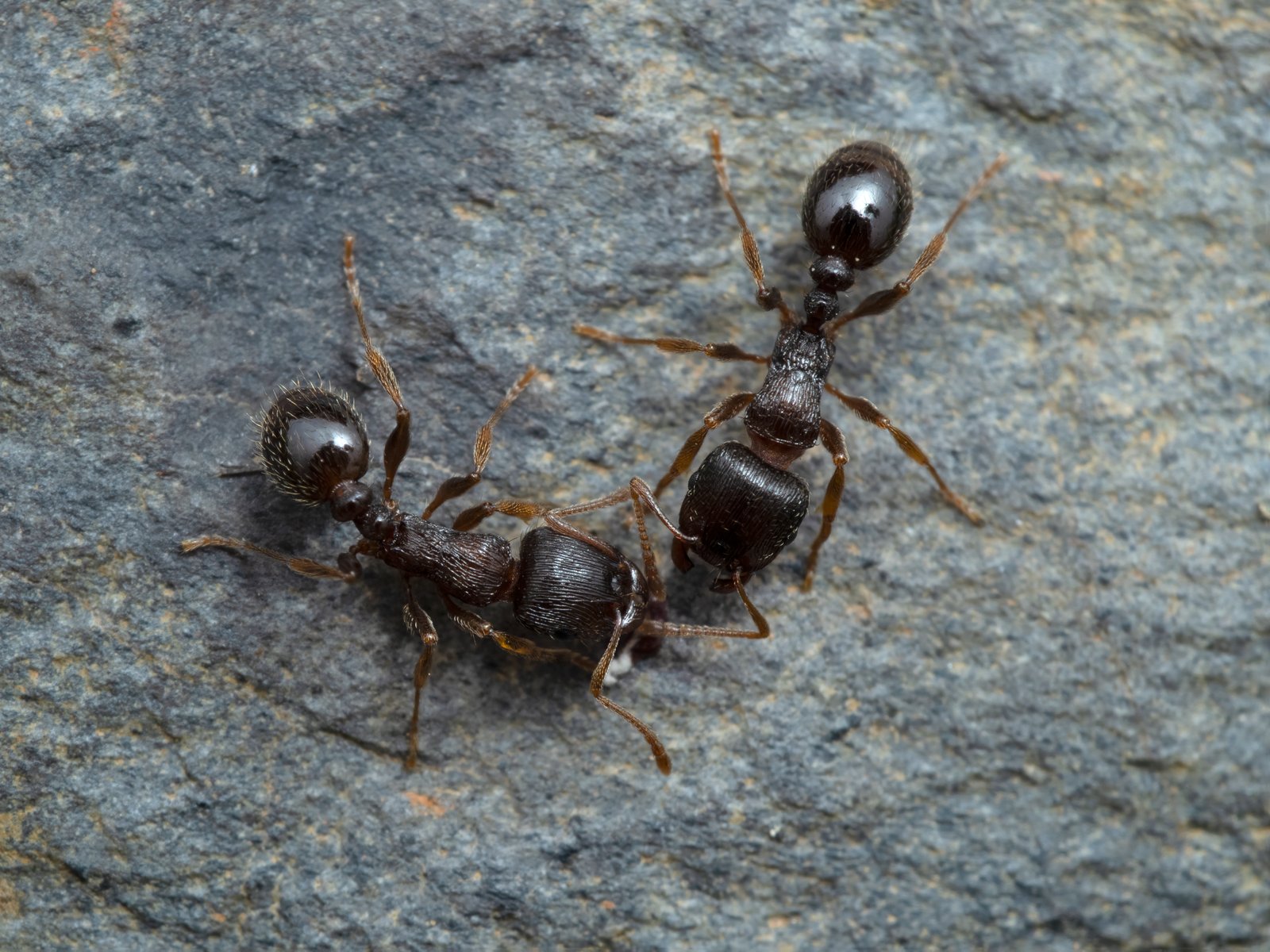
Different ant species require fundamentally different approaches. Pavement ants nest in soil under driveways and slabs; the colony is right there at the foundation. Odorous house ants form supercolonies with multiple queens and split into satellite colonies when disturbed — which is what makes them get worse if you spray them wrong. Carpenter ants nest in wood, sometimes a tree 50 feet from the house with workers traveling in nightly. Pharaoh ants are an indoor species that lives entirely inside walls.
The treatment for each is different. Identifying what you actually have is step one — and it’s free. Take a photo and send it to us and we’ll tell you what species you’re dealing with.
Step 2: Stop Disrupting the Colony
This sounds backwards, but it’s important. Don’t spray ant trails with repellent products until you know what species you have. With odorous house ants and pharaoh ants in particular, repellent sprays trigger colony budding — the colony splits in two, multiple new queens start laying, and your one problem becomes several.
If you have to do something while you wait to be sure, use a baited approach (gel bait or granular bait) rather than spray. Bait gets carried back to the queen.
Step 3: Address the Source, Not the Symptom
This is where DIY hits its limit. The ants you see indoors are foragers — maybe 10% of the actual colony. The colony itself (queen, brood, food storage) is somewhere you can’t easily reach: under a slab, in a hollow tree, behind a wall, in an outdoor soil mound. Killing the foragers doesn’t affect the colony’s reproduction rate at all.
Professional treatment works because we go after the colony directly:
- Non-repellent perimeter spray — workers walk across the treated area without sensing it, pick up the active ingredient on their bodies, and carry it back to the colony. From there it spreads ant-to-ant through grooming and contact. This is the most-used tool and the most reliably effective.
- Targeted baits when they’re a good fit for the species and situation — bait gets carried back to the queen and shared through the colony. Effective when the ants take to it; less effective when they don’t.
- Direct nest treatment when we can locate the actual colony (carpenter ant parent colonies, in particular).
This is the difference between a one-week reprieve and a permanent solution.
Step 4: Close the Door Behind Them (Things You Can Do Yourself)
Even after the colony is eliminated, new colonies will find your home if the conditions that drew them are still there. We handle the treatment side; the environmental side is something you can mostly knock out on a Saturday with a tube of caulk:
- Seal foundation cracks and gaps around utility penetrations with silicone caulk or expanding foam — the same gaps that let mice in are highway on-ramps for ants.
- Eliminate moisture issues in basements, crawl spaces, and around the foundation — especially for carpenter ants, which need damp wood. This usually means fixing leaks, improving drainage, or running a dehumidifier in chronically damp spaces.
- Keep food sealed indoors — particularly anything with sugar or grease residue.
- Trim trees and shrubs away from the house — branches touching siding are literally bridges for ants.
These are DIY changes; we don’t do insect exclusion work ourselves. But knocking down even half of them makes our treatments hold longer.
The Realistic Plan
If you’re seeing a few ants a year on a kitchen counter, hardware-store gel bait is probably enough. Place it on the trail, wait, replace as it disappears. The colony will weaken.
If you’re seeing ants every spring, in multiple rooms, or you’ve found frass (sawdust-like debris that indicates carpenter ants), DIY isn’t going to solve it. Our quarterly pest control program includes ant monitoring and treatment at every visit, and adjusts seasonally — spring foragers get a different approach than fall colony-preparation activity. For one-time problems, our targeted ant control service identifies the species and treats the colony directly.
Either way, the permanent fix starts with knowing what you have.