Clover Mite Identification & Control
Bryobia praetiosa
Tiny bright red arachnids that mass on sunny exterior walls in spring and fall — and occasionally swarm indoors through window cracks. Harmless but a nuisance.
Quick Identification
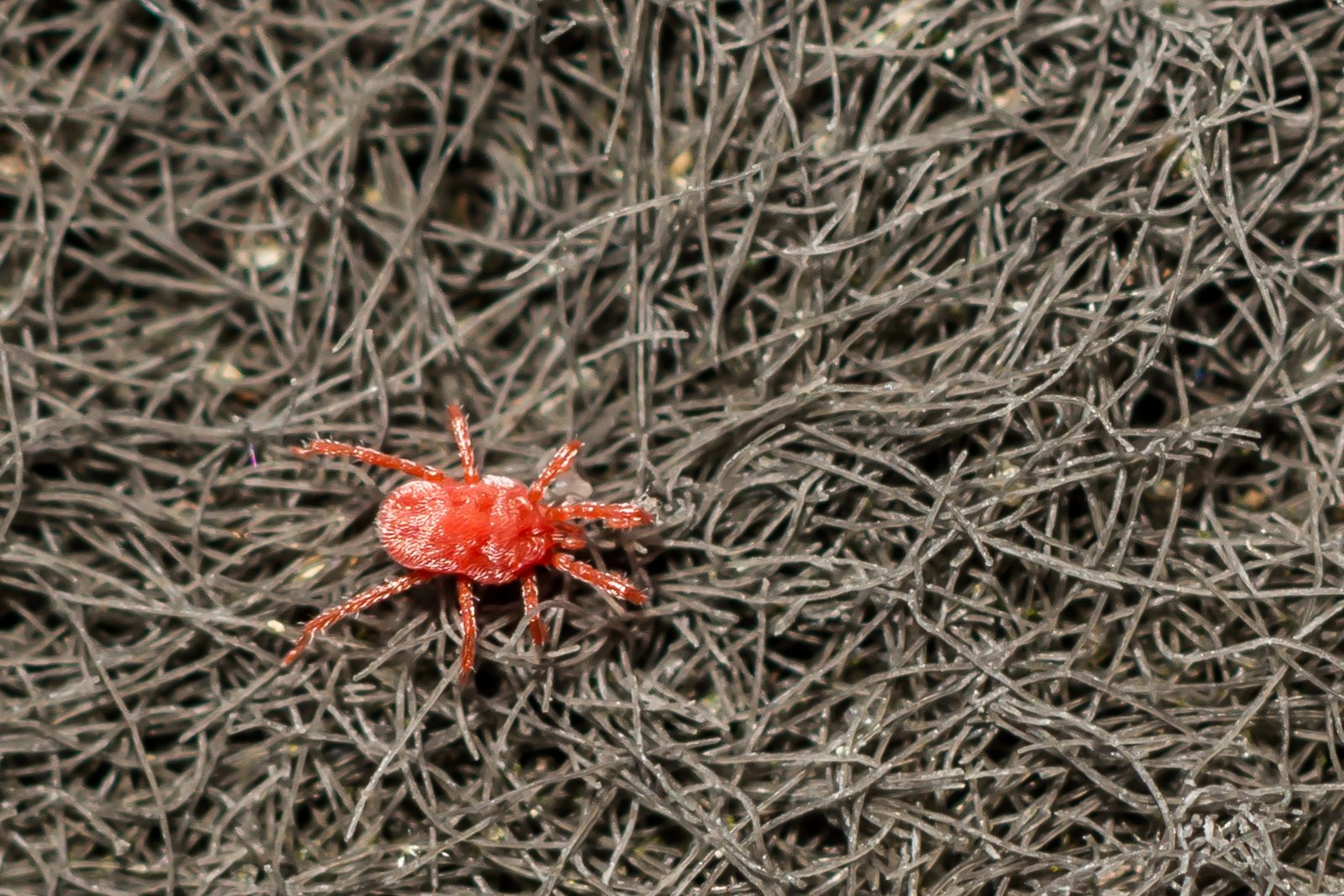
- Size: About 0.75 mm — smaller than a pinhead; looks like a slow-moving red dot to the naked eye
- Color: Bright reddish-brown to dark red; leaves a red smear when crushed (often mistaken for blood from a bed bug)
- Key Features: Eight legs (arachnid, not an insect); the front pair of legs is noticeably longer than the other six and held forward like antennae — the easiest field ID
- Distinguishing Trait: Mass on south- and west-facing exterior walls in cool, sunny weather; appear suddenly and in large numbers
- Active Season: Spring (April–May) and fall (October); inactive during hot summer and cold winter
- Risk Level: Low — does not bite, does not feed on people, pets, food, or fabric; purely a cosmetic nuisance
Why Clover Mites Show Up Indoors
Clover mites live on lawns and feed on grass and clover. They're harmless outside — usually invisible — and most homeowners never notice them. The problem starts when the conditions outdoors change. A long stretch of warm weather, a sudden cold snap, fresh mowing, or just the natural seasonal shift in spring and fall triggers thousands of mites to migrate up the sides of nearby buildings.
Once on the wall, they squeeze through any tiny gap they find — around windows, through weep holes in brick veneer, under the bottom edge of siding, around utility penetrations. Indoors they cluster on south- and west-facing window sills, on curtains, on the ceiling near windows. They don't reproduce indoors and don't survive long — most die within a day or two of getting inside — but during an active outbreak you can find hundreds on a single windowsill.
Crushing them leaves bright red smears that look alarmingly like blood. This is just the mite's body pigment, not blood from a bite. Clover mites cannot bite — their mouthparts are designed for piercing plant cells, not skin.
Where Clover Mites Show Up in Will County
Newer homes with fresh sod or heavily fertilized lawns. Clover mite populations explode in lawns that get a lot of nitrogen fertilizer. New construction in places like Grande Park, the newer subdivisions in Shorewood and Oswego, and the recently developed parts of Plainfield often have heavier clover mite pressure during their first 5–10 years.
South- and west-facing exterior walls. The walls that get the most afternoon sun are the ones clover mites prefer to climb. Brick and stucco hold heat better than vinyl siding and tend to attract more mites.
Homes with vegetation right against the foundation. Lawn grass, ground cover, or clover growing right up to the siding gives mites a direct path onto the wall. A bare-soil or mulched buffer of 18–24 inches dramatically reduces wall climbing.
Around windows on the first floor. Once inside, clover mites cluster near light sources — almost always on or near windows. They rarely venture far into the room.
Signs You Have a Clover Mite Problem
Tiny red dots on windowsills, curtains, or window frames. Often discovered when someone notices movement on the sill in afternoon sunlight. The dots are mites; tap one with a paper towel and you'll see the characteristic red smear.
Red streaks on light-colored walls or fabric. Where mites have been crushed against a surface — often by accident as someone walks past a window or pulls a curtain.
Visible masses on exterior walls. During an outbreak, you may see dense patches of moving red dots on the sunny side of the house — sometimes mistaken for paint discoloration until you look closely.
Seasonal timing. Clover mites appear in waves in spring (typically late April through May) and again in fall (October). Outside those windows, they're almost never an issue.
What Works for Clover Mite Control
A few mites on the windowsill don't need any treatment — just vacuum them up (don't crush them; the red stains are hard to remove from fabric). If they're appearing in small numbers and only briefly, the population usually resolves itself within a few weeks.
Heavier outbreaks — hundreds of mites on a window, recurring every spring or fall, or visible masses on exterior walls — are a different situation. The fix is a combination of exterior treatment and structural exclusion:
- Perimeter barrier treatment around the foundation in early spring (before the first big outbreak) interrupts the migration up the wall
- Exterior spot treatment on the south- and west-facing walls where mites are massing knocks the population down quickly
- Sealing exterior gaps around windows, weep holes, and utility penetrations stops them from getting indoors
- Vegetation buffer — clearing grass and clover back 18–24 inches from the foundation reduces the source population on the wall
Sanctuary treats clover mite outbreaks as part of our perimeter service — sometimes folded into a quarterly visit if the timing aligns with the spring or fall round, or as a standalone visit if the outbreak is heavy and outside the normal schedule. Send us a photo of what you're seeing and we'll tell you whether you're in nuisance territory or treatment territory.
Related pests
Sources: University of Illinois Extension — Clover Mites; Iowa State University Extension; Penn State Extension.
Spotted clover mite at your home?
Free inspection — we ID the species, confirm the issue, and give you a fixed quote before any treatment.