House Centipede Identification & Control
Scutigera coleoptrata
House centipedes are consistently one of the most alarming indoor encounters for homeowners. They’re fast, they’re alien-looking, and they tend to appear.
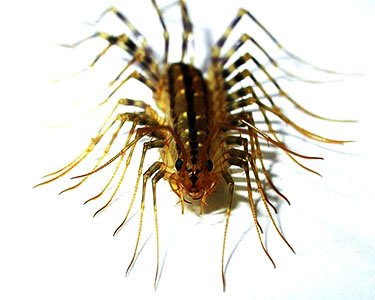
Photographed by Sanctuary Pest Control in Plainfield, IL.
Quick Identification
- Size: Body about 1–1.5 inches; legs can make overall span appear much larger
- Color: Yellowish-gray with dark banding on legs and body
- Key Features: 15 pairs of extremely long, banded legs; very fast runner; flattened body; large compound eyes
- Habitat: Moist indoor spaces: basements, bathrooms, crawl spaces, laundry rooms
- Active Season: Year-round indoors
- Risk Level: None to humans — beneficial predator; technically capable of biting but rarely does
The Pest That’s Actually Helping You
House centipedes are consistently one of the most alarming indoor encounters for homeowners. They’re fast, they’re alien-looking, and they tend to appear suddenly on bathroom walls or basement floors at the worst possible moments. The instinct is to kill them immediately and call an exterminator. Here’s the counterintuitive truth: house centipedes are one of the most effective natural pest controllers in your home.
House centipedes are voracious predators. They hunt and eat spiders, ants, cockroaches, silverfish, carpet beetle larvae, bed bugs, and virtually any other small pest in your home. Unlike other centipede species, the house centipede has adapted to live entirely indoors, breeding and hunting in moist basements, crawl spaces, and bathrooms year-round. Their large compound eyes give them excellent vision, and their speed makes them efficient hunters.
The Illinois Department of Public Health notes that while house centipedes possess venom-injecting appendages (modified front legs, not true fangs), they rarely bite humans. When they do, the result is similar to a mild bee sting — painful briefly but not dangerous.
What They’re Telling You
Here’s the real insight: if you’re seeing house centipedes regularly, they’re there because there’s a food supply. A healthy centipede population means there’s a healthy population of the pests they eat. Killing the centipedes removes the symptom but not the cause. Addressing the underlying pest population — ants, spiders, silverfish, or moisture-loving insects — will naturally reduce centipede numbers.
Reducing moisture in basements and crawl spaces (dehumidifiers, fixing leaks, improving ventilation) addresses both the centipedes and the conditions that attract their prey. If centipede sightings are frequent enough to be a concern, contact Sanctuary Pest Control at 815-993-3472 for a professional assessment — we’ll identify what’s feeding them and address the root cause.
Related pests
Sources: Illinois Department of Public Health (dph.illinois.gov) — Occasional Invaders.
Spotted house centipede at your home?
Free inspection — we ID the species, confirm the issue, and give you a fixed quote before any treatment.