
Red-Headed Ash Borer Identification & Control
Neoclytus acuminatus
A wasp-looking beetle emerging from your firewood is probably a red-headed ash borer. It can't infest your house. Here's how to tell.
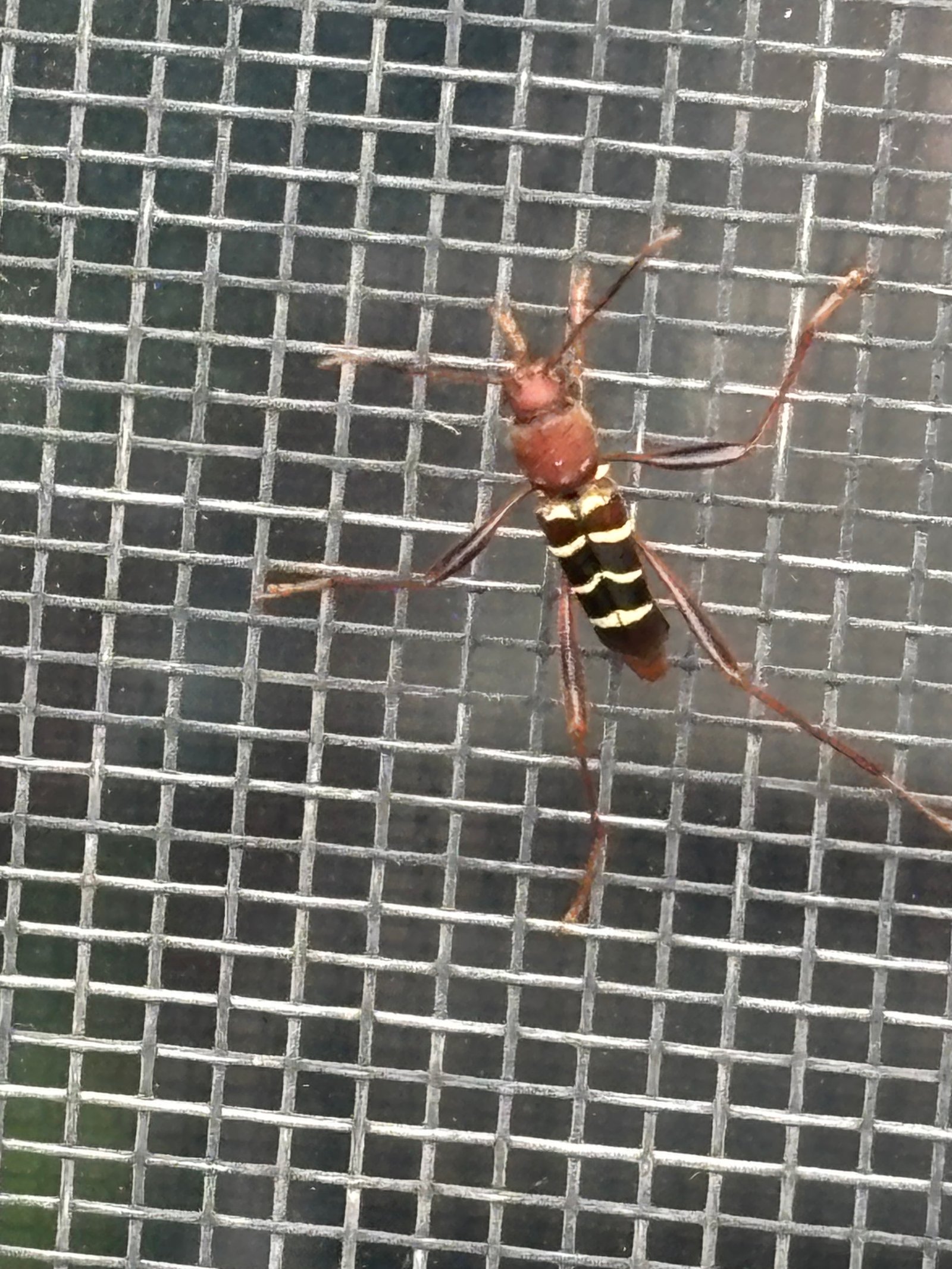
Photographed by Sanctuary Pest Control in Plainfield, IL.
A slender, wasp-striped beetle appears indoors in late winter, seemingly out of nowhere. It's almost always a red-headed ash borer, and it almost always came in with the firewood.
Quick Identification
- Size: About ½ to ⅝ inch long
- Color: Brick-red head and thorax; darker wing covers crossed by four narrow yellow bands
- Key Features: Slender, fast-moving, long reddish middle and hind legs; antennae about half the body length; overall shape and coloring mimic a wasp
- Not a wasp: No stinger, no narrow wasp waist, and the front wings are hard beetle wing covers rather than membranous
- Habitat: Recently dead or dying hardwood — ash, hickory, oak, maple. Indoors, almost always from stored firewood
- Active Season: Emerges in early spring outdoors; indoors any time firewood is kept warm
- Risk Level: Harmless — cannot infest structural lumber, furniture, or living trees
Wasp Mimicry, Beetle Reality
The red-headed ash borer is a longhorned beetle in the family Cerambycidae, and the resemblance to a wasp is deliberate. The brick-red forebody, the four crisp yellow bands, the slender build, the quick nervous movement — it all adds up to something birds have learned to avoid. It's a defensive bluff, and a good one.
It doesn't hold up under a close look. There's no stinger, no pinched waist, and the front wings are rigid wing covers rather than the clear membranous wings of a wasp. The very long reddish hind legs are another tell.
The lookalike worth knowing is the banded ash borer, Neoclytus caprea. That one is darker — brown to nearly black — and has a line of fine pale hairs across the thorax, with the first two bands curving to nearly meet. If the thorax is plain brick-red with no pale stripe, you have the red-headed ash borer.
Why It's in Your House
This is the part that matters, because the usual scenario is alarming.
Red-headed ash borers lay eggs in recently dead or dying hardwood. The larvae bore through the sapwood and take months to develop, timed so that adults emerge in spring. When a homeowner splits and stacks seasoned hardwood — ash and oak especially — and brings a load into a warm garage, basement, or living room, that warmth convinces the developing beetles that spring has arrived early. They emerge in December or February into a house.
So a wasp-striped beetle appears on the ceiling in the middle of winter, and the reasonable conclusion is that something is boring through the house.
It isn't. Red-headed ash borers can only develop in wood that still has bark and moisture — recently dead standing timber, fresh-cut logs, unseasoned firewood. They cannot infest kiln-dried, milled framing lumber, finished flooring, furniture, or trim. And they don't attack living trees. The beetle that emerged from your firewood has nowhere to go and nothing to eat in your house.
This is the key distinction from powderpost beetles, which can re-infest dry wood indoors and do require treatment. If you're finding fine, flour-like powder beneath small round holes in finished wood, that's a different insect and a different situation.
What to Do
Carry it outside. That's the whole treatment.
To prevent a repeat: store firewood outdoors, off the ground, and only bring in what you'll burn within a day or two. Wood kept in a warm garage or basement for weeks is what triggers early emergence. Don't spray firewood with insecticide — you'll be burning it indoors, and it doesn't work anyway.
Sanctuary Pest Control doesn't treat for red-headed ash borers, because there's nothing to treat. If you're finding beetles emerging from wood indoors and want to be sure they aren't powderpost beetles, send us a photo — that's a distinction worth getting right.
Related pests
Sources: University of Illinois Extension; Oklahoma State University Extension — Redheaded Ash Borer; North Carolina State Extension; BugGuide.net.
Not sure what you're looking at?
Send us a photo. We'll identify it and tell you what you're dealing with — even when it's not something we treat.